Someone says something. How do you know it's true?
A five step method to examine what someone tells you, with one worksheet you fill in as you go.
Every number is correct. Every award is genuine.
Can still be wrong.
 6 min read
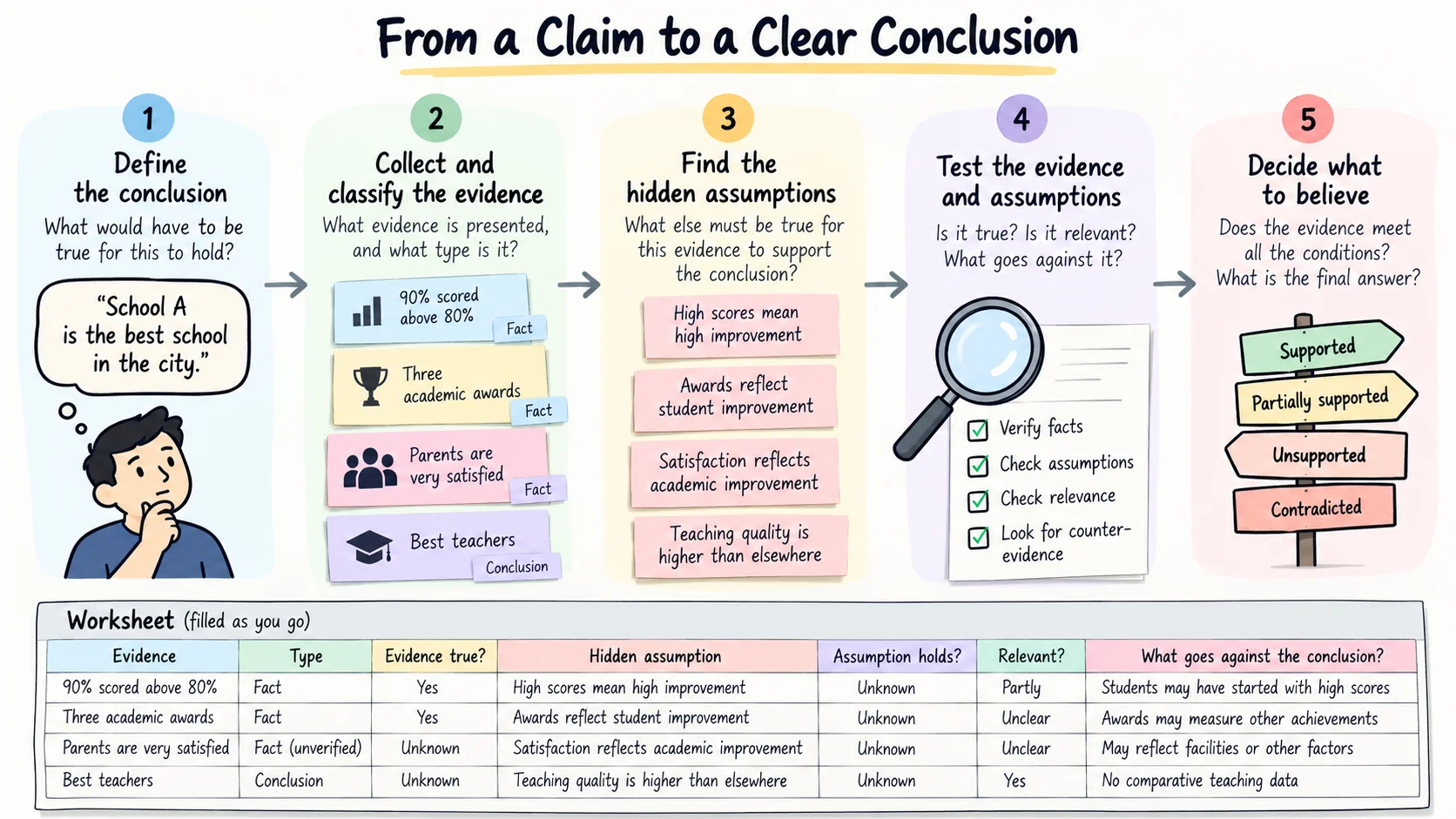
All the facts in an argument can be true, and its conclusion can still be wrong. The weak point is often the assumptions that connect the facts to the conclusion. This method makes you define what the conclusion needs, collect and classify the evidence, find the hidden assumptions, test them, and then say plainly what the evidence supports.
Someone tells you that a school is the best in the city. They show you examination results, awards and parent reviews.
You verify everything. Every number is correct. Every award is genuine.
So, is it the best school?
Not necessarily.
All the facts in an argument can be true, and its conclusion can still be wrong.
The problem is not always the facts. It is often the assumptions connecting those facts to the conclusion.
Here is a five step method to examine what someone tells you. You record your findings in a single worksheet as you go, and each step fills in part of it.
| Worksheet column | Filled in |
|---|---|
| Evidence | Step 2 |
| Type | Step 2 |
| Evidence true? | Step 4 |
| Hidden assumption | Step 3 |
| Assumption holds? | Step 4 |
| Relevant? | Step 4 |
| What goes against the conclusion? | Step 4 |
1. Define the conclusion
Start with what the person wants you to believe.
For example: “School A is the best school in the city.”
Now ask: What would have to be true for this conclusion to hold?
First, define what the conclusion means for your decision.
If you are choosing a school for your child, “best” might mean academic improvement, quality of teaching, overall development or some combination of these.
Suppose academic improvement matters most to you. Then the evidence must establish three conditions:
- How much students improve after joining the school.
- How that improvement compares with other schools.
- How much of the improvement can reasonably be attributed to the school.
Write these conditions down. You will come back to them in Step 5.
2. Collect and classify the evidence
List each piece of evidence presented in the first column of the worksheet.
- 90% of students scored above 80%.
- The school won three academic awards.
- Parents are extremely satisfied.
- The school has the best teachers.
Classify each one in the Type column:
- Fact: Something that can be verified.
- Interpretation: Meaning assigned to facts, such as “the awards show academic excellence.”
- Assumption: Something accepted without establishing it.
- Conclusion: A judgment that requires its own supporting evidence.
Words such as best, excellent, strong or effective usually signal a conclusion. “The school has the best teachers” is one.
Who is telling you?
Also ask who is providing this information and what they might gain if you believe it.
A school advertising itself has an obvious interest in attracting admissions. That doesn’t make its information false.
But the more the source gains from your belief, the more independent verification you should seek before accepting its evidence.
3. Find the hidden assumptions
For each piece of evidence, ask:
What else must be true for this evidence to support the conclusion?
Consider: “90% of students scored above 80%.”
For this to show that School A improves students the most, we might be assuming:
- Students entered School A with abilities comparable to students elsewhere.
- Students at other schools improve less.
- Higher examination marks reflect better teaching.
- Any improvement came from the school rather than private tuition or other factors.
None of these assumptions was necessarily mentioned. Yet the conclusion depends on them.
You don’t have to examine every small assumption. Start with the evidence the argument relies on most, and record the assumption it depends on most heavily in the worksheet.
Every assumption necessary to reach the conclusion must either be validated or remain an explicit gap.
4. Test the evidence and assumptions
For each row of the worksheet, run three checks.
A. Is it true?
Test the evidence and its assumption separately. A true piece of evidence can rest on a false assumption.
- For facts, verify them using reliable sources.
- For interpretations, check whether the facts justify the explanation.
- For assumptions, check whether there is evidence to accept them.
Record Yes, No or Unknown in both the Evidence true? and Assumption holds? columns. Unknown does not count as verified.
B. Is it relevant?
Does the evidence help establish the conditions you defined in Step 1?
Three academic awards may be genuine. But they might tell us little about how much the school improves its students.
True evidence can still be irrelevant to the conclusion.
C. What goes against the conclusion?
Look for evidence that challenges it or suggests another explanation.
Perhaps other schools achieve better academic improvement. Perhaps School A admits students who already perform exceptionally well.
Test these possibilities where you can. Anything you cannot test stays in the worksheet as an open gap.
If the evidence is a conclusion, drill down
Take “The school has the best teachers.”
Ask what supports that judgment.
Perhaps the answer is: “Their students score higher.”
Now examine that statement. Are the scores verified? Were the students comparable? Could something else explain the difference?
Repeat until you reach facts, interpretations or assumptions that can be tested.
5. Decide what to believe
Read down the completed worksheet.
| Evidence | Type | Evidence true? | Hidden assumption | Assumption holds? | Relevant? | What goes against the conclusion? |
|---|---|---|---|---|---|---|
| 90% scored above 80% | Fact | Yes | High scores mean high improvement | Unknown: no starting scores | Partly | Students may have started with high scores |
| Three academic awards | Fact | Yes | Awards reflect student improvement | Unknown: award criteria not checked | Unclear | Awards may measure other achievements |
| Parents are very satisfied | Fact (unverified) | Unknown | Satisfaction reflects academic improvement | Unknown | Unclear | Satisfaction may reflect facilities or other factors |
| Best teachers | Conclusion | Unknown | Teaching quality is higher than elsewhere | Unknown | Yes | No comparative teaching data |
Now return to the three conditions from Step 1:
- How much students improve: Not established. We have final scores but no starting scores.
- How that compares with other schools: Not established. We have no comparative data.
- How much is due to the school: Not established. Admissions and private tuition remain possible explanations.
None of the three conditions is met, and every assumption linking the evidence to the conclusion remains an open gap.
The original conclusion, “School A is the best school in the city,” is Unsupported.
What the evidence does support is narrower: “90% of School A’s students scored above 80%.”
Four possible outcomes
You can classify any conclusion using four outcomes:
| Outcome | Meaning |
|---|---|
| Supported | The verified evidence meets all the conditions defined in Step 1. |
| Partially supported | Some conditions are met, but important gaps remain. |
| Unsupported | The available evidence does not meet the conditions. |
| Contradicted | Reliable evidence conflicts with the conclusion. |
The method, in one line
The method is the same whether someone is recommending a school, selling a product, presenting a business case or explaining something in the news.